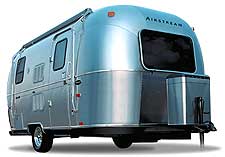
Hit the road with art and nostalgia
Pamela LeBlanc
AUSTIN, Texas - Sleek,
modern marvels they're not. But who needs that when you've got
the quirky, kitschy appeal of a vintage travel
trailer?
From the compact Teardrop to the ubiquitous silver Airstream, recreational vehicles from the 1940s, '50s and beyond have caught the eye of collectors of Americana - and people just looking for an affordable way to travel. You can buy vintage trailers on eBay, log on to online discussion groups to chat about their virtues, or join a club, such as Women on the Fly, a New Mexico-based group whose fly-fishing members customize their trailers by painting them with cowgirls and fishing rods. Even celebrities such as Tom Hanks and Sean Penn are in on the trend, modernizing and personalizing their own Airstream motorhomes. Here in Austin, at least one woman is revamping old trailers, turning them into kicky, themed works of art that can be pulled behind a car or truck. Other Austinites are using remodeled RVs as portable design exhibits and work spaces. The allure of the old RVs, they say, is akin to the magic of owning a restored classic Ford Mustang or '57 Chevy. "It's something different ... but you can still use it," said David Woodworth, an RV historian from California who has collected and restored 39 antique trailers and motorhomes (which, as the name suggests, have their own motors and don't have to be towed) and plans to open a museum in Southern California on the history of auto camping. "They're not as comfortable as the new ones, but if you're a weekender and go out once in a while, it's not terribly expensive. You don't have a lot invested in it and you can doctor it up any way you want." Sam McComb of Austin started six months ago with a trio of tired-out trailers she tracked down on eBay. She ripped out carpeting, replaced rotting wood, scrubbed for hours and then pulled out the paintbrushes. The result? A 1940s Teardrop she calls Beefo, decked out in cinnamon brown with white spots and a pair of horns; a 1962 Shasta Mini dressed up in a cowboy-boot motif she calls Boot Scoot Buggy; and her favorite, a Southwestern style turquoise, red and navy drenched 1972 Terry she calls The Jewel of Santa Fe. McComb used to design iron furniture and home decor that was made by artisans in Mexico. But the poor economic environment made the business difficult, and for McComb, the dream of turning an old Airstream into a portable canvas was too much to ignore. "I always kind of wanted to do one for myself," she said. "It just brings out the creative juices ..." Now she resells the renovated trailers, which range in price from $3,800 to $10,000, through her company, Haute Wheels. Some have stoves, sinks, ovens, showers, toilets and even bathtubs. The themes, she says, just come to her. Next on her list are a trailer with a whopper-sized trout painted on the side, a hula-cowgirl motif and one inspired by a New York checkered cab. "They have character," McComb says. "When people pass me in one of these, you can see them pointing and smiling. What could be better than to make someone smile?" But McComb quickly learned it isn't easy getting the trailers in working order. "She was hideous," she says, glancing at one trailer where a carpenter is busy cutting boards to replace those that have rotted. She looks at another RV she's recently remodeled, a 1972 Airstream Ambassador. Unlike her other projects, which are whimsically decorated, this one retains its plain silver finish. Inside, one wall has been laminated in wine bottle labels. "People who like the Airstream don't want you to touch the outside," McComb said. "I had to make it more sophisticated." McComb, by the way, isn't much of a camper herself. "The last time my two boys and husband said, 'We're going to take you camping for Mother's Day,' I said, 'OK, I get to pick the place - and I pick the Four Seasons,' " McComb said. Kate Catterall, who teaches design at the University of Texas, has turned a 1959 Airstream Bambi trailer into a mobile exhibit and installation art piece that studies our relationship with the American landscape. While it still looks like a trailer on the outside, the inside is all swirling blue lines and curvy Fiberglas, with an area to show a video. "It's a funky little piece," she said. She bought the trailer five years ago, drawn to its lines and the Airstream's iconic role in America's past. "I think it's partly nostalgia for the ideal postwar period," she said of the trend to restore such vehicles. "It's just this idea of traveling back to that ideal moment - the American Golden Age, the high point for the car and the Eisenhower highway ..." Her exhibit, she says, is a call to go back to that experience and avoid a prescribed route. Like Catterall, Eric Beggs, a professional photographer in Austin, incorporated an old RV into his work. Three years ago, he bought a 1971 Airstream and turned it into a 28-foot mobile darkroom. After spending years making makeshift dark rooms in oddball places such as showers and kitchens, the RV made perfect sense. Besides, he liked the streamlined look of the Airstream. "My mantra was, 'It must be on wheels.' I could take it on location for long periods of time and do work on the spot," he said. "I tell my friends I'm working my way up to campground host." Now that most of his work is done digitally, he doesn't use the trailer as often for photography. But it's still parked in the yard in southeast Austin, where it works well as extra office space and satisfies his pangs of nostalgia. "It just has that cocoonish, sheltering feel to it," he said. For most vintage trailer buffs, the appeal goes beyond practicality. They bond with their trailers and what they stand for. And their numbers seem to be growing. Woodworth, the RV historian, says his hobby was a rarity when he started collecting vintage trailers and motorhomes 30 years ago. (His latest acquisition, he has to tell you, is a 1937 Pierce Arrow Travelodge.) These days, vintage trailers have become trendy - and useful - collectibles, he says. "Most people aren't even aware that people camped in the 1920s and '30s," he said. "The fact that it's an 'I didn't know that' has a certain amount of appeal. It's also how primitive they were compared to the really opulent units they have today." |